Showing posts with label Architecture. Show all posts

Sunday, 13 April 2014

Reactive Cloud Actors: no-nonsense MicroServices

[Level C3]

This post is not directly about MicroServices. If that is why you are reading it, might as well stop now. Apparently, we are still waiting as for the definition to be finally ratified. The definition, as it stands now, is blurry - Martin Fowler admits. This post is about Actors - the cloud ones - you know. After finishing reading it, I hope I have made it effortlessly clear how Reactive Cloud Actors are the real MicroServices, rather than albeit light RESTful Imperative MicroServices.

Watching Fred George delivering an excellent talk on High-Performance Bus inspired me to start working on the actors. I am still working on a final article on the subject but this post is basically a primer on that - as well as announcement of BeeHive mini-framework. The next section on actors is taken from that article which covers the essential theoretical background. Before we start, let's make it clear that the term Reactive is not used in the context of Reactive Extensions (Rx) or Frameworks, only in contrast to imperative (RPC-based) actors. Also RPC-based is not used in contrast to RESTful, but it simply means a system which relies on command and query messages rather than events.

UPDATE: The article is now published on infoq here. 

Actors

Carl Hewitt, along with Peter Bishop and Richard Steiger, published an article back in 1973 that proposed a formalism that identified a single class of objects, i.e. Actors, as the building blocks of systems designed to implement Artificial Intelligence algorithms.

According to Hewitt an actor, in response to a message, can:
  1. Send a finite number of messages to other actors
  2. create a finite number of other actors
  3. decide on the behaviour to be used for the next message it receives
Any combination of these actions can occur concurrently and in response to messages arriving in any order - as such, there is no constraint with regard to ordering and an actor implementation must be able to handle messages arriving out of band. However, I believe it is best to separate these responsibilities as below.

Processor Actor

In a later description of the Actor Model, first constraint is re-defined as "send a finite number of messages to the address of other actors". Addressing is an integral part of the model that decouples actors and limits the knowledge of actors from each other to mere a token (i.e. address). Familiar implementation of addressing includes Web Services endpoints, Publish/Subscribe queue endpoints and email addresses. Actors that respond to a message by using the first constraint can be called Processor Actors.

Factory Actor

Second constraint makes actors capable of creating other actors that we conveniently call Factory Actors. Factory actors are important elements of a message-driven system where an actor is consuming from a message queue and create handlers based on the message type. Factory actors control the lifetime of the actors they create and have a deeper knowledge of the actors they create - compared to processor actors knowing mere an address. It is useful to separate factory actors from processing ones - in line with the single responsibility principle.

Stateful Actor

Third constraint is the Stateful Actor. Actors capable of the third constraint have a memory that allows them to react differently on subsequent messages. Such actors can be subject to a myriad of side-effects. Firstly, when we talk about "subsequent messages" we inherently assume an ordering while as we said, there is no constraint with regard to ordering: an out of band message arrival can lead to complications. Secondly, all aspects of CAP applies to this memory making a consistent yet highly available and partition tolerant impossible to achieve. In short, it is best to avoid stateful actors.

Modelling a Processor Actor

"Please open your eyes, Try to realise, I found out today we're going wrong, We're going wrong" - Cream
[Mind you there is only a glimpse of Ginger Baker visible while the song is heavily reliant on Ginger's drumming. And yeah, this goes back to a time when Eric played Gibson and not his signature Strat]


This is where most of us can go wrong. We do that, sometimes for 4 years - without realising it. This is by no means a reference to a certain project [... cough ... Orleans ... cough] that has been brewing (Strange Brew pun intended) for 4 years and coming up with an imperative, RPC-based, RESTfully coupled Micro-APIs. We know it, doing simple is hard - and we go wrong, i.e. we do the opposite: build really complex frameworks. 

I was chatting away on twitter with a few friends and I was saying "if you need a full-blown and complex framework to do actors, you are probably doing it wrong". All you need is a few interfaces, and some helpers doing the boilerplate stuff. This stuff ain't no rocket science, let's not turn it into.

The essence of the Reactive Cloud Actor is the interface below (part of BeeHive mini-framework introduced below):
    /// <summary>
    /// Processes an event.
    /// 
    /// Queue name containing the messages that the actor can process messages of.
    /// It can be in the format of [queueName] or [topicName]-[subscriptionName]
    /// </summary>
    public interface IProcessorActor : IDisposable
    {
        /// <summary>
        /// Asynchrnous processing of the message
        /// </summary>
        /// <param name="evnt">Event to process</param>
        /// <returns>Typically contains 0-1 messages. Exceptionally more than 1</returns>
        Task<IEnumerable<Event>> ProcessAsync(Event evnt);

    }

Yes, that is all. All of your business can be captured by the universal method above. Don't you believe that? Just have a look a non-trivial eCommerce example implemented using this single method.

So why Reactive (Event-based) and not Imperative (RPC-based)? Because in a reactive actor system, each actor only knows about its own Step and what itself does and has no clue about the next steps or the rest of the system - i.e. actors are decoupled leading to independence which facilitates actor Application Lifecycle Management and DevOps deployment.
As can be seen above, Imperative actors know about their actor dependencies while Reactive actors have no dependency other than the queues, basic data structure stores and external systems. Imperative actors communicate with other actors via a message store/bus and invoke method calls. We have been this for years, in different Enterprise Service Bus integrations, this one only brings it to a micro level which makes the pains event worse.

So let's bring an example: fraud check of an order.

Imperative
PaymentActor, after a successful payment for an order, calls the FraudCheckActor. FraudCheckActor calls external fraud check systems. After identifying a fraud, it calls CancelOrderActor to cancel the order. So as you can see, PaymentActor knows about and depends on FraudCheckActor. In the same way, FraudCheckActor depends on CancelOrderActor. They are coupled.

Reactive
PaymentActor, upon successful payment, raises PaymentAuthorised event. FraudCheckActor is one of its subscribers and after receiving this event checks for fraud and if one detected, raises FraudDetected event. CancelOrderActor subscribers to some events, including FraudDetected upon receiving which it cancels the order. None of these actors know about the other. They are decoupled.

So which one is better? By the way, none of this is new - we have been doing it for years. But it is important to identify why we should avoid the first and not to "go wrong".

Reactive Cloud Actors proposal


After categorising the actors, here I propose the following constraints for Reactive Cloud Actors:
  • A reactive system that communicates by sending events
  • Events are defined as a time-stamped, immutable, unique and eternally-true piece of information
  • Events have types
  • Events are stored in a Highly-Available cloud storage queues allowing topics
  • Queues must support delaying
  • Processor Actors react to receiving a single and then do some processing and then send back usually one (sometimes zero and rarely more than one) event
  • Processor Actors have type - implemented as a class
  • Processing should involve minimal number of steps, almost always a single step
  • Processing of the events are designed to be Idempotent
  • Each Processor Actor can receive one or more event types - all of which defined by Actor Description
  • Factory Actors responsible for managing the lifetime of processor actors
  • Actors are deployed to cloud nodes. Each node contains one Factory Actor and can create one or more Processor Actor depending on its configuration. Grouping of actors depends on cost vs. ease of deployment.
  • In addition to events, there are other Basic Data Structures that contain state and are stored in Highly-Available cloud storage (See below on Basic Data Structures)
  • There are no Stateful Actors. All state is managed by the Basic Data Structures and events.
  • This forms an evolvable web of events which can define flexible workflows
Breaking down all the processes into single steps is very important. A Highly-Available yet Eventually-Consistent system can handle delays but cannot easily bind multiple steps into a single transaction.

So how can we implement this? Is this gonna work?

Introducing BeeHive


 BeeHive is a vendor-agnostic Reactive Actor mini-framework I have been working over the last three months. It is implemented in C# but frankly could be done in any language supporting Asynchronous programming (promises) such as Java or node.

The cloud implementation has been only implemented for Azure but implementing another cloud vendor is basically implementing 4-5 interfaces. It also comes with an In-Memory implementation too which is only targeted at implementing demos. This framework is not meant to be used as an in-process actor framework.

It implements Prismo eCommerce example which is an imaginary eCommerce system and has been implemented for both In-Memory and Azure. This example is non-trivial has some tricky scenarios that have to implement Scatter-Gather sagas. There is also a Boomerang pattern event that turns a multi-step process into regurgitating an event a few times until all steps are done (this requires another post).

An event is model as:

[Serializable]
public sealed class Event : ICloneable
{

    public static readonly Event Empty = new Event();

    public Event(object body)
        : this()
    {        
       ...
    }

    public Event()
    {
        ...
    }

    /// <summary>
    /// Mrks when the event happened. Normally a UTC datetime.
    /// </summary>
    public DateTimeOffset Timestamp { get; set; }

    /// <summary>
    /// Normally a GUID
    /// </summary>
    public string Id { get; private set; }

    /// <summary>
    /// Optional URL to the body of the message if Body can be retrieved 
    /// from this URL
    /// </summary>
    public string Url { get; set; }

    /// <summary>
    /// Content-Type of the Body. Usually a Mime-Type
    /// Typically body is a serialised JSON and content type is application/[.NET Type]+json
    /// </summary>
    public string ContentType { get; set; }
        
    /// <summary>
    /// String content of the body.
    /// Typically a serialised JSON
    /// </summary>
    public string Body { get; set; }

    /// <summary>
    /// Type of the event. This must be set at the time of creation of event before PushAsync
    /// </summary>
    public string EventType { get; set; }

    /// <summary>
    /// Underlying queue message (e.g. BrokeredMessage in case of Azure)
    /// </summary>
    public object UnderlyingMessage { get; set; }

    /// <summary>
    /// This MUST be set by the Queue Operator upon Creation of message usually in NextAsync!!
    /// </summary>
    public string QueueName { get; set; }


    public T GetBody<T>()
    {
       ...
    }

    public object Clone()
    {
        ...
    }
}

As can be seen, Body has been defined as a string since BeeHive uses JSON serialisation. This can be made flexible but in reality events should normally contain small amount of data and mainly basic data types such as GUID, integer, string, boolean and DateTime. Any binary data should be stored in Azure Blob Storage or S3 and then path referenced here.

BeeHive Basic Data Structures

This is a work-in-progress but nearly done part of the BeeHive to define a minimal set of Basic Data Structures (and their stores) to cover all required data needs of Reactive Actors. These structures are defined as interfaces that can be implemented for different cloud platforms. This list as it stands now:
  • Topic-based and simple Queues
  • Key-Values
  • Collections
  • Keyed Lists
  • Counters

Some of these data structures hold entities within the system which should implement a simple interface:

public interface IHaveIdentity
{
    Guid Id { get; }
}

Optionally, entities could be Concurrency-Aware for updates and deletes in which case they will implement an additional interface:

public interface IConcurrencyAware
{
    DateTimeOffset? LastModofied { get; }

    string ETag { get; }
}


Prismo eCommerce sample

Prismo eCommerce is an imaginary eCommerce company that receives orders and processes them. The order taking relies on an eventually consistent (and delayed) read model of the inventory hence orders can be accepted for which items are out of stock. Process waits until all items are in stock or if out of stock, they arrive back in stock until it sends them to fulfilment. 
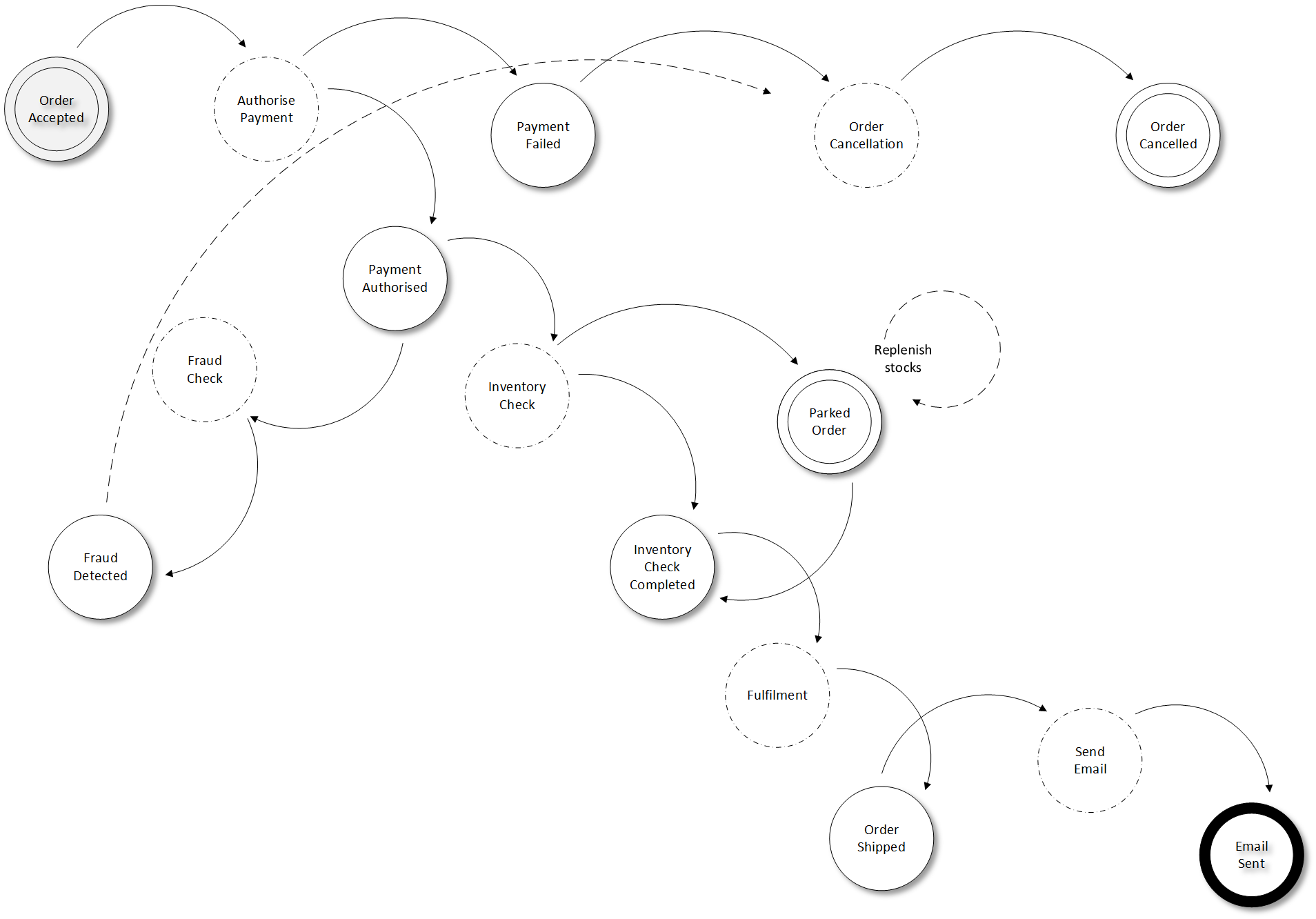
Prismo eCommerce states (solid), transitions (arrows) and processes (dashed)

This sample has been implemented both In-Memory and for Windows Azure. In both cases, the tracing can be used to see what is happening outside. In this sample all actors are configured to run in a single worker role, although they can each run in their own roles. I might provide a UI to show the status of each order as they go through statuses.

Conclusion

Reactive Cloud Actors are the way to implement decoupled MicroServices. By individualising actor definitions (Processor Actor and Factory Actor) and avoiding Stateful Actors, we can build resilient and Highly Available cloud based systems. Such systems will comprise a evolvable webs of events which each web defines a business capability. I don't know about you but this is how I am going to build my cloud systems.

Watch the space, the article is on its way.

Saturday, 5 April 2014

Web APIs and n+1 problem

[Level C3]
You are probably familiar with n+1 problem: when a request to load 1 item turns into n+1 requests since the item has n other associated items. The terms has been mainly described in the context of Object Relational Mappers (ORMs) when lazy loading associated records have caused additional calls to the RDBMS database resulting in poor performance, locks, deadlocks and timeouts.

This article now has been published on @infoq. Please view the article here.


This article is humbly dedicated to Adrian Cockcroft and Daniel Jacobson for their inspiring yet ground breaking works.

Saturday, 12 October 2013

API Layer and its responsibilities - a REST viewpoint

[Level C4] With the emergence and popularity of REST APIs, there is a need to define a layer dedicated to the performing API-related functions. This article tries to define these responsibilities and separate it from the responsibility of other layers.

TLDR; If you are putting business logic of your domain in your API Layer (which is the presentation layer of your service), you are doing it wrong.


Layered (Tiered or N-Tiered) Architecture is a software design pattern that implements a software system in a stack of layers. Each layer has a distinct responsibility and has a dependency upon the deeper layer - with the deepest layer normally accessing a relational database.

This pattern, also known as the Layers pattern, was formalised in the book Pattern-Oriented Software Architecture: Layers pattern "helps to structure applications that can be
decomposed into groups of subtasks in which each group of subtasks is at a particular level of abstraction." This pattern emerged as a replacement to the Client-Server architecture and became very popular in late 90s and early 2000s.

Service Oriented Architecture (SOA) did not change the popularity and importance of tiered architecture since each service contains the tiers inside it (Figure 1)

Figure 1 - Layered Architecture in SOA
Layers are usually domain-agnostic and can be uniquely identified across different implementations and systems. The layers themselves are not necessarily physical, i.e. deployed on different machines; they can be simply logical implementations in different libraries - or even in the same library. What identifies a layer is its responsibility not its physical location.

There are different approaches in identifying and naming layers across a system stack. Historically, three tiers have been identified: Presentation Layer, Business Layer and Data Access Layer (Figure 2).
Figure 2 - Traditional Layers
This traditional layering is still prevalent and popular in the industry. As the names imply:

  • Presentation Layer deals with user interactions
  • Business Layer contains the business logic of the domain
  • Data Access Layer is concerned with the persistence of the domain objects
Sometimes a Service Façade Layer is identified between Business Layer and Presentation Layer which is responsible to organise the business services as a coarsely granular set of services. This layer is usually very thin.

However, Eric Evans in his Domain Driven Design book introduced an alternative layering which was a better fit for DDD: Presentation Layer, Application Layer, Domain Layer and Infrastructure Layer. (Figure 3)
Figure 3 - Layers according to DDD (two alternative interpretations)

In this model, responsibilities of each layer is defined as below:

  • Presentation Layer has the same responsibility as the traditional model: user interaction (user could equally be a machine or human)
  • Application Layer which I prefer to call Workflow Layer is the thin layer that connects and coordinates coarse granular business tasks. This layer can have state regarding the state of a business activity. 
  • Domain Layer is the heart of the system which contains all the business logic
  • Infrastructure Layer is responsible for persistence, passing messages to buses and providing a framework and utility across other layers. As such, all layers could have access to this layer. 

API Layer

In none of the above we saw any mention of an API Layer, so what is an API Layer? API Layer is the outermost layer of a service and is concerned with presentation of a bounded context services through the API. In other words, in an SOA, we can call the Presentation Layer of an SOA Services its API Layer.

This layer was very thin or non-existent in services exposed through SOAP but it is an important layer when it comes to REST. The reason for its lack of importance in SOAP services is the fact that an RPC service can be easily exposed through SOAP with some configuration and little or no coding - using various tools and frameworks that make this possible with a click of a button. WCF is an example of this in the Microsoft stack while IBM Websphere is a popular tool in the Java world capable of achieving this.

API Layer Responsibilities

With REST, however, API requires a distinct layer that is responsible for translating the HTTP semantics to and from the code world. It also responsible for cross-cutting concerns such as monitoring, logging, identity, etc. We will be looking into each and expanding the meaning and examples.

Table 1 - API Layer responsibilities (in REST)
Bear in mind, none of the above involves any domain-related business logic. In other words, API Layer can use a common framework that can be equally used among different services since it is mainly domain-agnostic and does not implement any.business logic. As such, this IBM's online article (Figure 4) turns into How Not To Do API Layer since it puts Domain classes in the API Layer.

Figure 4 - This is IBM's view of an API Layer according to this article.
However, I will call it How Not To Design An API LAYER.
(Source: http://www.ibm.com/developerworks/library/j-ts3/layers.gif)
So let's look into each responsibility in depth. But before we do that it is important to define what we mean by no-business-logic. Since API Layer has an access to underlying layers, it is bound to touch the higher level abstractions of the domain. However it does not implement any of the business logic and simply directs the calls to the layers below.

HTTP Semantics

Talking HTTP is the most important responsibility of a REST API. HTTP provides different axis of sending intent or data which cannot be easily mapped to an RPC method's parameters. This problem is known as the impedance mismatch between RPC and HTTP.

Figure 5 - Impedance mismatch between HTTP/REST and RPC.
Challenge of shaping HTTP requests and responses from RPC methods
is the most important responsibility of the API Layer. (From the book Pro ASP.NET Web API)
Different frameworks provide different solutions to this problem but it is important to bear in mind that exposing a REST endpoint for your service means you need to a lot more to take advantage of all the flexibilities of HTTP messages.

Table 2 lists important HTTP semantics that are responsibility of a REST API Layer.

Table 2 - HTTP Semantics that are responsibility of a REST API Layer
A few points are important to consider. While, none of above are truly dependent on a domain's business logic, it is possible that it could require business decision in some form of configuration. For example, cache expiry interval is usually a concern that the business stakeholders need to understand and happy with. Or Hypermedia exposes the relationship of resources in your API but the API Layer should really just take the natural relationship defined in your domain and expose in HTTP.

Monitoring

If you have an API that you do not monitor its health, performance and usage, then this is not a serious API. Bear in mind that Quality of Service (QoS) is one of the mainstays of an API which can be translated into SLA. Regardless of whether your API is public or private, you have to monitor your API against its baseline.

Identity and Authentication

Very rarely, if ever, an API allows anonymous clients. Even if your API is free, you should build an identity mechanism such as an API Key. API Layer is responsible for turning identity/authentication mechanisms (Basic Authentication, OAuth, OAuth 2.0, Windows Authentication) into rich claim-based identity.

Please note that we did not mention Authorization. Authorization is a concern of deeper layers of the system and fully ingrained with Business Logic - as such is not suited for implementation in the API Layer.

Logging, tracing and documentation

Developing against an API is not an easy task and you should make it very easy for the clients of your API to be able to build, debug and deploy. This is most neglected feature of an API that can endanger success of your public API or private API within a big enterprise.

Monetisation and Capping?

Similar to Authorization, I am on the belief that monetisation and usage capping of an API is heavily dependent on business logic and information that are available in deeper layers. As such, I believe that monetisation and usage capping of an API must be implemented in deeper layers and not in the API Layer.

What about the relationship of the API with Server-side generated views?

A common question that crops up in the stackoverflow is how to lay out the architecture of web applications that historically were based around Server-side MVC Frameworks. For example, should a RoR web application use a Ruby-based API layer? Or if you are in the Microsoft world, should an ASP.NET MVC application use ASP.NET Web API services?

Well it depends. API Layer and Server-side MVC Frameworks both sit at the Presentation Layer. So you should not really add the networking and serialisation overhead of accessing an API Layer from Server-side MVC Frameworks if they are part of the same application. As we said, API Layer is a thin layer that is only responsible with the API centric responsibilities. In most cases, MVC Frameworks should directly use deeper layers of the system and sit side-by-side with the API Layer. However, if API Layer is the presentation layer of an SOA service and the MVC Framework uses multiple APIs to build the views, then it is OK to separate it from the API Layer.

Sunday, 10 March 2013

Pro tip: don't try abstracting the code world from the HTTP world

[Level T2] I have explained in my Part 5 of the Web API series how the world of HTTP (URI, headers, method, payload) meets the world of code (controller, actions, parameters, etc). This has partly been done in ASP.NET Web API in the media type formatter. And then I talked about the Tower Bridge of MediaTypeFormatter. The problem is these two worlds will eventually come to collide hard - if you ever try to abstract them away.

So what am I on about?

Problem is routing - as I have raised a few times before. And here I will try to explain why - and propose a solution.

The routes basically live in the application setup. You define them outside your controllers and actions - usually inside glolbal.asax or outside while being called on application startup. The idea is that no matter what your routing is, if set up correctly, the values will be populated in your actions - all parameters, and your data. And then your return some data which will be interpreted and serialised in your MediaTypeFormatters.

So what happens if I want to set the location header in the response to a POST method (when an item has been created)? Now I need to provide the parameters to the route to create a virtual link. Now here although I have been abstracted away from the route, I have to know the parameters to pass - this is where things start to get a bit hairy. I have defined a route somewhere else and yet I need to know about it here.

And that by itself is not a big problem. A bigger issue is that ASP.NET does the route matching linearly. So if I happen to define 1000 routes, and my 1000th route gets call often, I can be in trouble as performance can suffer: ASP.NET should always try to match to 999 routes until it hits 1000th.

But why should I have 1000 routes? What is wrong with /api/controller/id? I could end up with handful of routes? OK, here is the catch: routing was designed for a flat routing structure (and originally for ASP.NET MVC) while resource organisation in a Web API has to be hierarchical.

Another issue is hypermedia. Have you tried doing clean and robust hypermedia in Web API using the existing routing? Good luck with that one!

Another problem is the resource in the Web API's really elegant HTTP pipeline (which I love) is URL until it hits the controller dispatcher and then tries to find a matching controller and then action. As such, code part of the resource (controller, action, parameters) cannot programmatically (using attributes, etc) define a strategy to the delegating handlers since we do not yet know which controller or action will respond.

Resource organisation is the responsibility of the application

There were a few issues  raised with CacheCow in terms of cache invalidation of related resources. This is actually one of the fundamental scenarios that I designed CacheCow for. Problem is resource organisation is the responsibility of the application as such CacheCow cannot make any assumptions about the organisation of the resource. So the solution is for the application to describe resource organisation and the relationship of resources. This is definitely not easy - as again, world of routing is a disjoint one.

So here is what we need:

  • A hierarchical routing with a natural setup rather than arbitrary route definition 
  • Resources aware of related resources. As such a resource can define its hypermedia for the most part
  • Ability for resources to define their strategy when it comes to caching, etc


Once asked by Youssef Moussaoui - a developer in ASP.NET team - on what to improve in ASP.NET Web API, my immediate answer was routing. And not just routing, it is resource organisation.

So I know that ASP.NET will look into this but I probably will have a stab at this. We have defined the project Resourx which will look at this and try to achieve the 3 goals above. Watch the space!

Saturday, 24 November 2012

Introducing Client-Server Domain Separation


[Level C4]

If you have followed my posts on REST and its client-server implications, you already know I have a thing for the client-server relationship.

I have been thinking about Client-Server Domain Separation CSDS for a while. And I think it is time to do a brain dump.

TLDR;

So here is the definition CSDS - if you don't want to read the whole post. CSDS defines a single constraint which is just an expansion on REST's client-server constraint:
Client and server must define and live in their own bounded context. 
This will lead to 1) cleaner separation of concerns among clients and servers and 2) adoption of API as the building blocks of complex systems in an SOA world. CSDS is also not compatible with HATEOAS - as we will see. If you need to find out how such a seemingly trivial constraint can have such an impact, read the rest.

Background

REST defines a set of constraints that will lead to better architecture and design - well that is the claim but I personally do believe in it. One of those constrains is client-server. As far as REST is concerned, client and server are decoupled entities - these ideas were successfully used in the design of HTTP. Yet considering limitations of the clients back in the day REST dissertation was being written, I think we need to re-visit this constraint.

I suppose it all started with smartphones. We now have more processing power in our pockets than the Apollo that landed on the moon for the first time. Native apps allow for developing pretty complex applications while HTML/JS app has become a reality (better browsers, adoption of HTML5, better javascript runtime and development tools). 

The dilemma we are faced now is to decide where to implement a functionality (in other words put the business logic): client or server. Back in the late 90s or early 2000s we did not have a choice - we had to implement most of the functionality on the servers and use client-side code mainly for limited validation. We lived in a time of server dominance. Now we have the liberty to implement a sizeable chunk of functionality in both places but getting the balance right is difficult and has lead to mainly two opposing camps: Single Page Application followers and server domination supporters. I am more inclined towards the first but shall explain below why CSDS will lean more on the SPA side rather than server domination - although not as a matter of taste but as a matter of principle - question is whose concern is a functionality.

Other changes in the industry have contributed to the need to define client and server. Nowadays, it is only incidental that the client code in an html/js application is served from the server - we can package up javascript files with the application as in PhoneGap or Windows 8 metro applications. In mash-up applications, there is no single server defining the flow as such HATEOAS is meaningless.

Introduction

In here I briefly re-iterate what I explained in two related posts.

First of all, in order to decide where a functionality belongs - server or client - we need to understand whose concern it is. I talked about server-concern, client-server and mixed-concern and I explained their anti-patterns, each with an example.

In this post I tried to define client and server - as they stand now. So I am going to go back to the same definitions - with client definition slightly changed.

Server is responsible for defining a domain (server domain) and maintaining its state and consistency/integrity. Server is usually very complex but a good server hides its complexity behind its API. Server should not expose its internals to the outside world.

Server in CSDS


Client is responsible for using server(s) services to provide value to the end user - either directly if it is a client device or indirectly if client itself is a server. Client can also maintain a state but it is not its primary function.

We also touched on Application. For me application => value => user => client. Application, use and usability is mainly a client concern. Having said that, server will define a secondary level of API which could use underlying basic APIs and present a more useful representation of its state. As such, server is not completely oblivious to the user/value. For example, a high-street bank could have an API returning 10 most recent transactions on your account defined as a resource at /account/{id}/transaction/mostrecent,since this is a very common query. This is instead/or in addition to providing an API which allows client to define date ranges and number of transactions returned. The application sitting on a client device does have the liberty to show only 6 of them if its usability mandates such restriction.

CSDS definition

So CSDS can be seen as a superset style on the top of REST with a single constraint on REST's client-server constraint. This is similar to, for example, HATEOAS which builds upon hypermedia constraint. So the constraint is:
Client and server must define and live within their own bounded context.
In other words, decision to where put a functionality is to ascertain whose concern it is. Is that it? Yes, that is it. Yet, this is going to have quite a big impact as well as important repercussions.

First of all since each defines its own boundary, client's domain is separate from server's domain. Their interaction is only through the API. "Domain objects" in the diagram above are usually regarded as view-models which are a translated version of the corresponding models in these two different domains - which in DDD terms are called context map.

By keeping client and server in their own bounded context, internals of each can be changed independently. By separating the domains, we achieve the client-server decoupling which is the goal of the client-server constraint - as Fielding puts it.

So here are some of the aspects and implications of CSDS:

Client has full coherence of server's public domain

This means that client is free to have full coherence of server's public domain including all its public API, domain objects and schemata. It is able to call, discover and make full use of the public API in any order or fashion it needs.

Server is responsible for versioning its public domain

In CSDS, client building dependency on the top of the public domain is not regarded harmful and actually is seen as essential. Server already knows that by changing the public domain, it will be breaking clients as such server is responsible for visioning its public domain.

Server has got no clue about the client

In CSDS, server has no reliance on its knowledge about the client calling it. Of course, in HTTP, it can use user-agent header for statistical purposes. Or in the case of OAuth, it can know the name of the application and perhaps even limit the scope of the public API according to that but this is an authorization concern - authentication and authorization of the calls are server concerns. In other words, it should not make any assumptions about the client, client device or its capabilities.

Server got no clue about the client - one of the clients could be a server itself (not shown, could not find the original visio to add the server :( )

CSDS, HATEOAS and hypermedia

CSDS is not compatible with HATEOAS. Why? Well, HATEOAS talks about hypermedia (a server concern but part of public domain) as the engine of the application. What application? Server got no clue about it. When I am listening to Spotify, I can tweet the song I am listening to. Publishing this tweet is no different to doing this from a twitter client, TuneIn radio client, etc. Server does not know what application is using it (although as we said it could know the name of the application in OAuth as a string) or where in the application this tweet happens. As such it cannot be the engine of the application. Also in a mash-up application, no single server could be the engine - there are multiple servers. 

CSDS regards hypermedia an important aspect of REST; it is a semantic web of interconnected resources. Client will have full coherence of the axes of such relationships and can effectively use to navigate the semantic web - since it is part of the public domain. But for it to become the engine of the application is server dominance.

Server has a lot to worry about

CSDS acknowledges utmost complexity of the server. Reliable storage, big data, high availability HA, sharding, resilience, redundancy, etc are all server concerns. Implementing the right server-side architecture is not easy as such server is best to focus on its own concerns rather than dominating the client by implementing client's concerns too.

CSDS leads to a cleaner SOA, especially when client itself is a server

Recent server-side challenges and trends in achieving a scalable and highly available architecture has added the focus for achieving the right balance in the client-server separation.

Listening to Adrian Cockcroft's talk in Cambridge on Netflix's architecture and having read Daniel Jacobson's book, I have a lot of appreciation for what these guys are doing and I think this will become a roadmap for a cleaner and more decoupled SOA. Adrian explained how in Netflix, they have used a web of micro-SOA services through REST APIs to create a resilient architecture whereby they even send chaos monkeys and gorillas to bring down servers or even server zones. I believe this is only possible with separating domains of each micro-SOA service. So a lot of kudos to them and it is a place to watch.

Saturday, 22 September 2012

Take your Web API service consumption up to 11 with CacheCow.Client

ASP.NET Web API is here and a lot of teams have already started building software using it. If you have followed this and other blogs on webapibloggers.com, you probably have seen many various possibilities and avenues this framework brings for designing and building clean and scalable services.

ASP.NET Web API exposes all the goodness of HTTP. Caching is an important feature of HTTP and ASP.NET Web API allows for building services and clients that take advantage of this feature. I, along with a few friends in the Web API community, have been busy building caching extensions for Web API in a project called CacheCow which is hosted on GitHub.

CacheCow has two separate components: server and client. These will be used independently by service providers (server) and their consumers (client).

Server component allows for easy handling of HTTP caching scenarios on server by generating ETag, responding to validation of cache (see earlier posts on this subject, especially this and for full list here), cache invalidation and storage of cache metadata. Storage of cache metadata is possible in various stores, currently in-memory and SQL Server have been implemented and RavenDB and Redis is on the pipeline [UPDATE: RavenDB is implemented and NuGet package is available here]. Since storage has been abstracted away, any storage mechanism can be plugged in without making any server changes.

Client component looks after making cache-aware requests, cache validation and cache storage. Currently in-memory and file-based storage is available but other stores such as Redis, SQL Server, MongoDB and RavenDB are in the pipeline. Since storage has been abstracted away, any storage mechanism can be plugged in without making any client changes. One of important features of storage is total and per-site quota.

It is important to note that while clients can be browsers or native Apps (WPF, Silverlight, iOS, Android, etc), arguably more often than not they will be server components themselves. For example, an ASP.NET web site can call services of an ASP.NET Web API server. Also middleware components could similarly use resources exposed by Web API. As such it is very crucial that cache storage solutions are performant, scalable and configurable.

In this post, I will look into CacheCow.Client a little but more. For more info, you can read previous posts on the topic in this blog.

CacheCow.Client alternatives

The only alternative to CacheCow.Client (that I am aware of) is using WinINET caching. Internet Explorer also uses this so the cache store will be the same. This is basically windows' HTTP request stack which has been exposed in .NET Framework since v 2.0 through WebRequest:

RequestCachePolicy policy = 
        new RequestCachePolicy( RequestCacheLevel.Default);
WebRequest request = WebRequest.Create(uri);
request.CachePolicy = policy;
WebResponse response = request.GetResponse();

As you can see, we can define a cache policy which will be applied to the request and according to the policy, Internet Explorer cache is used. Cache policy has a few possible values that are defined here. Notable values include:

  • CacheOnly: retrieves the request only from cache
  • BypassCache: does not use cache at all and goes straight to the server
  • CacheIfAvailable: retrieves from local or intermediate cache if resource available otherwise retrieve from server
  • Default: Similar to previous but current cache policy takes effect 

This same mechanism is now exposed in HttpClient but basically is built on the top of WebRequest. Henrik fully covers this feature in his blog here.


Basically in order to use WinINET caching with the new Web API stack, you need to create an HttpClient but provide WebRequestHandler as the MessageHandler:

HttpClient client = new HttpClient(new WebRequestHandler()
                           {
                               CachePolicy = new RequestCachePolicy( RequestCacheLevel.Default)
                           });
// this is a sample. It is not advised to use .Result since can lead to deadlock!
var httpResponseMessage = client.GetAsync("http://carmanager.softxnet.co.uk/api/car/3").Result;
var httpResponseMessage2 = client.GetAsync("http://carmanager.softxnet.co.uk/api/car/3").Result;

Using this feature, you can enable caching with little coding on the client.

Why I would choose CacheCow.Client rather than WinINET

Because it goes to 11! As we saw, it is very easy to get started with caching in HttpClient. But as we noted, it is very likely that HttpClient could be used in a server context hence having a reliable and scalable solution is very important in production.

Here are a few advantages of CacheCow.Client over WinINET (or rather disadvantages of WinINET):

1. Caching will be shared with Internet Explorer

In a production scenario, you need an implementation which is predictable and reliable. If someone uses Internet Explorer on the machine, storage area for your application's resources will be taken by just simple browsing. This can lead Internet Explorer to flush application resources in order to store resources for the browsing session. 

2. You have little control over quota

With CacheCow.Client, you can define a global and a per-site quota for storage of resources while such feature is not accessible (although there could be some registry entries for changing these variables) in WinINET caching. Also these variables could be overwritten by installation of a newer version of Internet Explorer.

3. Cache is local to the machine and cannot be shared across servers

In a production scenario, it is desirable to be able to store caches in a central store so network traffic and requests could be limited while with WinINET caching, each server will use its own local cache store.

4. WinINET is file-based

With WinINET, cache is stored in a file location while for a high-throughput production environment, robust caching using solutions such as Redis is required. CacheCow client by abstracting the storage can use any number of storage mechanisms such as Redis, MongoDB, RavenDB, etc.

5. CachePolicy is global for the HttpClient instance

Sometimes you might need to bypass caching. With WinINET, this has to be done with changing policy at the client level which applies across all requests for that HttpClient while CacheCow.Client respects will not use cached resources if you set CacheControl header of the request to no-cache. This basically recommended implementation based on HTTP specification (RFC2616).

6. With WinINET you do not know if request was retrieved from cache

With WinINET, there is no way to tell if response was retrieved from the cache or origin server. CacheCow.Client provides x-cachecow header which provides various information which can be used for debugging and troubleshooting scenarios.

Introducing CacheCow.Client.FileCacheStore

Last week I finished first version of a persistent cache store which is file based. This is available using NuGet and (package name is CacheCow.Client.FileCacheStore) and the code available at GitHub.

Using this persistent store is very easy. After getting the package from NuGet, create an HttpCient while as a delegating handler, pass CachingHandler (covered before here) while setting the store to a new instance of FileStore. While creating a FileStore, you need to specify a folder for storing the cached resources:

var httpClient = new HttpClient(
 new CachingHandler(
 new FileStore("c:\\Cache"))
{
 InnerHandler = new HttpClientHandler()
});

That is all you have to do! Now all your requests will store cacheable resources in a file-based persistent store. 

Currently for quota it uses default values but I am in the process of exposing values so you can configure quota.

CacheCow roadmap

After exposing quota settings, I will be working on CacheCow.Client.RedisCacheStore for a high throughput production level cache storage.

Please keep me posted by your comments, feedback and raising bug/issues on the GitHub page. You are awesome!

Sunday, 5 August 2012

Hierarchical routing for ASP.NET Web API: RESTful resource organisation


Introduction and motivation

[Level T3] A question keeps popping up on various forums (StackOverflow, ASP.NET Forums, etc) on how to define routing in ASP.NET Web API. And more important is that there does not seem to be any consensus on how to approach this - well probably since ASP.NET Web API is still in preview (RC).

In this post, I want to have a fresh look at routing in ASP.NET Web API and present a hierarchical model for organising resources.

Background

Resources are important part of RESTful architectual style. In REST all server operations (API) are defined as interactions with resources - in HTTP terms it would mean Verb interactions with URLs. This is in contrast with RPC style where server operations are defined as method calls. 

ASP.NET Web API's routing mirrors ASP.NET MVC routing - similar to some other aspects of Web API which uses ASP.NET MVC as the baseline since it is a familiar model for developers.

Routing was first introduced to ASP.NET by MVC. Later on routing code was integrated into system.web.dll. 

Routing in ASP.NET MVC is very flat since all routes are defined from the root. This was one of the reasons MVC Areas were introduced to add another layer to top root routes. This can work for MVC but RESTful resource organisation usually requires more nested structure while using conventionally routing can result in configuration burden as well performance penalty.

How routing works

MVC (and Web API) routes are generally designed for a handful (and in most cases less than 100) routes. You were expected to use the default route for most cases and add a few more routes for occasional cases where the pattern was different. This in fact worked in most MVC applications but RESTful resource design requires richer and a more nested structure as we will see below.

Route definition in ASP.NET Web API - as you all have probably used and know - is based on adding route to the RouteCollection:

var routes = GlobalConfiguration.Configuration.Routes; // in web hosted environment
routes.MapHttpRoute(
 name: "DefaultApi",
 routeTemplate: "api/{controller}/{id}",
 defaults: new { id = RouteParameter.Optional }
);

Each mapping will add a new HttpRoute object to the collection. HttpRoute itself is an implementation of IHttpRoute:

public interface IHttpRoute
{
    string RouteTemplate { get; }

    IDictionary<string, object> Defaults { get; }

    IDictionary<string, object> Constraints { get; }

    IDictionary<string, object> DataTokens { get; }

    HttpMessageHandler Handler { get; }

    IHttpRouteData GetRouteData(string virtualPathRoot, HttpRequestMessage request);

    IHttpVirtualPathData GetVirtualPath(HttpRequestMessage request, IDictionary<string, object> values);
}

Most important method is GetRouteData where the matching takes place. Basically if an implementation of IHttpRoute returns a non-null IHttpRouteData then route has matched.

Now how the matching work? Well, RouteCollection will loop through all the routes and calls GetRouteData and the first one to return a non-null will be the matched route for a given URL:

// snippet from HttpRouteCollection
foreach (IHttpRoute route in _collection)
{
    IHttpRouteData routeData = route.GetRouteData(_virtualPathRoot, request);
    if (routeData != null)
    {
        return routeData;
    }
}

Did you notice something fundamental above? If you have 1000 routes and your given URL matches the 1000th route, GetRouteData (which involves complex and heavy string processing if you look at the Web API source code) has to be called for the first 999 routes and fail until it reaches your matched route. With 100, this probably not an issue but with numbers going up, performance will take a hit.

RESTful organisation of resources

This StackOverflow question is one of many questions on the Web API routing according to REST style. One of the main challenges is that, we as Microsoft developers, have used to design our API in an RPC fashion. This habit has been ingrained in our psyche since remoting days and then Web Services and more recently WCF. So it is only natural to fall into the same habit when designing or REST API.

Martin Fowler on his article Steps towards the glory of REST talks about 3 levels of REST implementation. We will be talking about the level 1 and briefly about 2. Level 3 which is the most noble constraint of REST focuses on hypermedia which is beyond the topic of our discussion.

So at the level 1, we design the server to expose its API as resources. In case of HTTP and URLs, this will look like the directory/file structure on the disk - and as such hierarchical. If we mix REST with DDD concepts, each aggregate root of the publicly exposed domain (which is called Server domain, see the post on Client-Server) will be exposed at the root (considering API root is /api/):

/api/{AggregateRoot}/{id}

An example for cars would be /api/Car/1243. As such, we would have a CarController that receives the id through the URL. Now all of this is easily achievable using the default route very much in the good old MVC fashion.

However, the picture gets more complicated when we want to expose the tyres of the car. Let's say a car has Front/Rear Left/Right tyres as such FL, FR, RL and RR. One approach would be to expose the tyres as the aggregate root and have an ID for each tyre:

/api/Tyre/1234567

Well, this will work but tyre is really not a aggregate root since it really would only have a meaning as part of the car. So ideally we should expose them only as part of a car:

/api/Car/1243/Tyre/FR

So we would need a TyreController to handle the scenario and in this case we need a route similar to below:

/api/Car/{carId}/{controller}/{id}

Now this can be written in the generic form of:

/api/{parent}/{parentId}/{controller}/{id}

But as you can see in this case we need to define carId as parentId. Also not all of the domain has similar constraints for ID so this approach will impose a heavy limitation on our routes. On the other hand, we might have more than one nested levels where this can be even more complexed.

In addition to entity levels, we also have operations. Operations also can be defined as a resource, for example in case of a puncture:

POST /api/Car/1243/Tyre/FR/Puncture

This will create a puncture in the tyre. When we say create, we do not mean that necessarily a physical record needs to be created against the tyre. In fact mapping between REST resources and domain models is usually loose. The point is every operation needs to exposed as a resource and all operations to be performed using HTTP verbs. For example, repairing puncture can be represented as:

DELETE /api/Car/1243/Tyre/FR/Puncture

So the operations will complicate the routing even more. If the domain is big and complex, we could end up with many routes. As such, the performance will be hampered and we end up with the burden of defining all these routes at the root level.


So what is the solution? Solution is to turn Web API's flat routing into a hierarchical one. 


Tuesday, 10 July 2012

What does REST's Client-Server mean now?

Introduction

[Level C4] In "What does coupling mean ...", we reviewed three client-server patterns (with their anti-patterns) based on the concern. In this post, we will carefully examine the new meaning of client-server web applications. This will serve as a primer on my new work to define Client Server Domain Separation (CSDS).

Motivation

As I explained in the coupling post, I was challenged by recent emergence of attempts to define client-server relationship, one of which being ROCA. There seems to be a recent trend in the REST-aware community by disgruntled developers who believe too much control has been shifted to the client-side. As such they are trying to come up with practices/styles to move some of the control back to the server.

Background

REST has a strong emphasis on separation of client and server. Fielding in his PhD dissertation outlines the constraint:
Separation of concerns is the principle behind the client-server constraints. By separating the user interface concerns from the data storage concerns, we improve the portability of the user interface across multiple platforms and improve scalability by simplifying the server components
As we saw in the coupling post, we need to understand if a functionality is client-concern, server-concern or mixed concern. Implementing the functionality in the wrong side of wire can be initially tolerated but finally takes its toll. Below we will try defining building blocks of our discussion.

When we talk about the domain below, we refer to the concerns implemented/expose in the client or server.

Server

Server is responsible for defining a domain (server domain) and maintaining its state and consistency/integrity. Server usually has very complex components yet it hides its complexity behind its services.

Server
Figure 1 - Server exposes a public domain hiding its complexity

Service is composed of API and domain objects. In a RESTful world, API is HTTP REST. Domain objects are representative of the server's domain model. While Server can have a complex domain, we refer to server domain as only the publicly available domain.

Server should not have a knowledge of the client type. Although such information can be shared with the server (for example through User-Agent header), it should not be used other than for auditing or statistics.

Domain objects sent to the client are usually looked down upon and treated as second class citizen. They are  sometimes called DTO (Data Transfer Object) or ViewModel. While this is OK in a server development scenario when the focus is to decide how much of the server's whole domain to be exposed, these models are not to be mistaken with Value Objects since they are entities (they have identity according to DDD).

Domain object can be a fully rendered HTML (markup) in its semantic form (i.e. no display semantics such as <b> or <i>). Documents are domain objects for example a blog domain has a post domain object.

Server itself can be a client of one or several servers. ifttt is a beautiful example of it. 

Client

Client is responsible for using server(s) services to provide value to the user. In the process, it defines a domain which is usually different from server domain, although there is always an overlap. Client has a life of its own, able to maintain some level of functionality with no server access.


Figure 2 - Client and server domains - now and before
Please note that we did not mention user on the definition of server. Server is being abstracted away from the user by the client. Client can still provide some of its values to the user even when server down. Funny enough, I lost connectivity for half an hour while I was typing this blog and I carried on typing. When re-connected, Blogger saved my worked.

So let's bring an example to highlight a few important points:

I love listening to online radio while working. I use TuneIn on my android to listen to music based on my mood. TuneIn is a great app that allows you to search online radios and podcasts. So one of the functionalities is the directory service of radio stations. This functionality is provided by TuneIn servers (that maintain the state and its consistency/integrity). It defines a server model that consists of name, URL, style, icon, etc. Client does not know how the directory is created or how often the information gets updated.
On the other hand, when I click on a station to listen, I connect to the radio server. Domain of the server has music streaming, current artist, etc. For the radio server, it is all the same if you listen to music in your browser or in the native client on your phone. Client does not know how music is stored, chosen, etc.
Now if I really like a song, I can share it in twitter. Twitter server, while for security reasons (OAuth) knows the application I am using, it does not really care. Publishing my tweet is all the same for it.

So as you can see, Twitter's server domain is fully concerned with users, their tweets, re-tweeting, etc while TuneIn client only cares about publishing a tweet, so their domains have a tiny (yet important) overlap.

Some the client functionality has nothing to do with server. Playing music on the device is fully a client concern so does not exist on the server domain. For example, online radio's streaming servers would not know if the data they are sending will be even heard by the user (e.g. speaker could be on mute or worse, the client uses the data for illegal dumping of the songs).

Let's have a look at Figure 2. I think our TuneIn example fully described the "Now" diagram so let's focus on the "classic" case. This is the classic client (a web application running on the browser - see below) where all the logic served by the server. In extreme cases, server even generates client scripts apart from hosting the static logic (Javascript). Client's domain is fully engulfed by the server meaning server is aware of all the client logic.

Does the classic client look to you as the REST Eutopia? Having read Fielding's dissertation snippet above, which one do you think represent REST better?

Web Application

What is a web application? This definition has been drastically changed over the last few years with the emergence of diverse client devices capable of running advanced Javascript or native code. Web applications can be found in the forms below (not particularly ordered and probably some missing):
  • Single Page Application (SPA) running on various devices including top-end mobile devices
  • Native rich clients on desktop/laptop
  • Native client apps on mobile devices
  • Bundled HTML/Javascript apps running on mobile devices (PhoneGap) or desktop (Windows 8)
  • Traditional web applications run by browsers
  • Browser as an application to display markup
Figure 3 - Server cannot really see behind the cloud and which client is using it


Web application is the usage abstraction of the client. While the server domain used to pretty much define the web application, client is becoming more and more important in defining it.

Now what does web do in the "web application"? Nowadays, almost every application is a web application: the client uses one or more cloud services to enrich the experience. Unless it is a simple drawing or editing tool, most applications are web applications.

Some of the forms deserve more attention. Bundled HTML/Javascript apps remind us that in some cases it is in fact incidental that the server hosts the files. Some Javascript files are hosted on CDN and downloaded and cached for a long time.

Also not all logic is Javascript. Microsoft RIA service (regardless of whether I like it or not - and I don't!) sends server's domain rules to the client very much like Javascript. Generating Javascript or binaries is all bad the same as it breaches client's independence.

Web Application and REST

Basing your web application on REST will help achieving better separation as well as making an efficient use of the web.

Having said that, today's world demands more and more from the computing industry. Server Push model (gaining popularity in node.js/websocket world) requires a stateful server which is a REST no-no but today's virtualisation and cloud elasticity has made scalability a much smaller problem.

For most web applications, however, following all REST constraints is the best practice as very few applications require Server Push model.

So what do I think of the new trend?

Well, I think the trend cannot resist the wind of change. Computing industry has been pushed to provide more value and has to do it cheaper, faster and richer. Separating client and server will help to achieve this more effectively:

With regard to ROCA I must say it is a worthwhile effort to understand the client and server interactions and contains useful common-sense practices. However I cannot subscribe to it since:

  • must-server advocates "classic" model (engulfed client) and ignores the client server separation prescribed by REST. 
  • It does not respect client domain (must-no-duplication) and it rules and logic.
  • Single-Page-Application is not ROCA-compliant (see discussions).
  • Not all clients are browsers, in fact less and less clients are browsers. ROCA is heavily targeted for browser applications with many of the constraints directly related to HTML, CSS or Javascript
  • It does not fully appreciate the inherent complexity of the client domain (must-jslimits and mustnot-jsengine)
  • A ROCA client will not be able to provide any useful offline feature
  • Includes lower-end non-browser clients yet does not appreciate upper-end clients (must-non-browser)

Conclusion

Client and server have their own domain - as REST prescribes. Server defines a domain and maintains its state and integrity. It hides its complexity behind its services while other than authentication and authorization does not need to know anything about the client.

Client through the usage of server(s) services provides value to the user. It defines its own domain that has overlap with server(s) domain.

Web application is a plethora of different devices and technologies. As such, defining a style requires considering all such scenarios.

We will talk more about Client-Server Domain Separation (CSDS) in the upcoming posts.

Sunday, 1 July 2012

The place of Extension Methods in Software Design


Introduction

[Level T3] Extensions methods - introduced back in .NET 3.0 - are useful tools in a .NET developer's toolset. Apart from their usefulness, extension method is not an inherently object oriented concept yet we use them more and more in our API designs.

Extension methods initially were used for those classes where we did not own the source code for. But nowadays we are using them increasingly for types where we do own the source.

This post aims to have an in-depth look at the place of extension methods in the API design.

Background

Definition of Extension Methods according to MSDN is:
Extension methods enable you to "add" methods to existing types without creating a new derived type, recompiling, or otherwise modifying the original type.
So as we all know, in order to create an extension method, we need to:
  1. Create a static non-generic class
  2. Create a static method
  3. Make the first parameter as the type we are trying to add the method, with the keyword this
For example (and one of my favourites), we can add this extension method to the object to replicate the T-Sql's IN operator:

public static bool IsIn(this object item, params object[] list)
{
 if (list == null || list.Length == 0)
  return false;
 return list.Any(x => x == item);
}

Now I can use this like an instance method:

string ali = "ali";
var isIn = ali.IsIn("john", "jack", "shabbi", "ali"); // isIn -> true

If I may digress a little bit here, this is not such a great implementation since:

var isInForInt = 1.IsIn(2, 3, 1); // isInForInt -> false!

As you have probably guessed, defining the extension method for object type will cause the boxed integers objects to be compared instead of integers themselves and they surely won't be equal. So a generic implementation will solve the problem:

public static bool IsIn<T>(this T item, params T[] list)
{
 if (list == null || list.Length == 0)
  return false;
 return list.Any(x => EqualityComparer<T>.Default.Equals(x, item));
}

Reality is, extension method only gives the illusion of method being on the type and what is being compiled is nothing but a plain old static method call. Having a look at the IL generated confirms this:

IL_0056:  call       bool ConsoleApplication1.ExtensionMethods::IsIn<int32>(!!0, !!0[])

ExtensionMethods above is the name of the static class I created for this method.

So extension methods are basically the same utility or helper static methods we have been writing only glamorised to look like instance methods. Yet they have the additional benefit of:

  1. It leads to much more readable and natural code.
  2. I do not have to know the name of the helper class whose static methods I am using - in fact the behaviour has nothing to do with the static class. That class is not really a class in a true sense since it does not exert state or behaviour. And that is why it has to be declared static: to make clear its design intentions.
  3. Fluent API can be easily designed for older types without touching them.
  4. Since it is not really an instance method call, it can be called on null instances. This is a desirable side effect since we can check for nulls in the extension method and cater for them (none of the "object reference not set to an instance..." nonsense!)
  5. Since it can be called on null instances, some type information for the null instance can be determined in the extension method (although it can be a base type or an interface) while this is not possible for a null object.

Extension methods when we do not own the type

This has been the typical scenario. We always wonder if for example string had a such and such method and there was no way to achieve this. Now using extension methods we can. This scenario can also apply to cases where a historic API has been released (and you own the API) but cannot be changed. In this case, your API can be enhanced using extension methods.

With such usage, there is no decision to be made hence the design has already been done. Extension methods serve mere as a nice utility and syntactical sugar.

One of the most useful use cases I have found is the function composition in functional programming in C# (see some examples in my other posts here and here). This is especially important since you can achieve readability by method chaining. For example:

  usingReflection
   .Repeat(TotalCount)
   .OutputPerformance(stopwatch, performanceOutput)();

In addition to the examples above, let's have a look at a simple example to swallow the exception and optionally log the error (note how the implementation reuses itself to swallow errors that could arise from logging):

public static class WrapSwallowExtension
{
 public static Action<T> WrapSwallow<T>(this Action<T> action, Action<Exception> logger = null)
 {
  return (T t) =>
       {
           try
           {
            action(t);
           }
           catch (Exception e)
           {
      if (logger != null)
       logger.WrapSwallow()(e);             
           }

       };
 }
}

So I can use:

string myString = null;
Action<string> action = (s) => { s.ToLower(); }; // reference null exception! 
action.WrapSwallow()(myString); // swallowed

Now here I created a new exception but when I am working in a functional scenario, I already have my actions and functions.

Extension methods when we own the type

I have heard some saying "Why would you wanna use an extension method when you own the code? Just add the method to the type."

There are cases where you own the type yet you would still use an extension method. Here we have a look at a few scenarios below.

Extension methods for interfaces

This is the most obvious use case. Most of the Linq library is implemented using extension methods (while Microsoft owns the types). An interface cannot have the implementation but you can use extension methods to add implemented enhancement to your interfaces.

Without getting into the debate whether implementing ForEach against IEnumerable<T> is semantically correct or not (don't! I am not going there) you might have noticed that the function only exists for the List<T> so you have to use ToList() to use the feature. Well, this can be easily done for IEnumerable<T> too:

public static class IEnumerableExtensions
{
 public static IEnumerable<T> ForEachOne<T>(this IEnumerable<T> enumerable, Action<T> action)
 {
  foreach (var t in enumerable)
  {
   action(t);
   yield return t;
  }
 }
}

In this particular example, I do not own the source for IEnumerable<T> but even if I had, I would only be able to associate implementation with the interface using extension methods.

Overloading

This is the next common case. If you are familiar with ASP.NET MVC, you probably have noticed that the most of the functionality of HtmlHelper class has been implemented using extension methods.

Html.TextBoxFor(x => x.Name)

In fact all different overloads of HtmlHelper for Textbox, RadioButton, Checkbox, TextArea, etc are implemented using extension methods. So the HtmlHelper class itself implements a core set of functionality which will be called by these extension methods.

Now lets look at this fictional interface:

public interface IDependencyResolver
{
   object Resolve(Type t);
   T Resolve<T>();
}

The interface has two methods for resolving the type, one using the generic type the other with the type instance. Whoever implements this will be most likely implementing the non-generic method and then make generic method call the non-generic one:

public interface IDependencyResolver
{
 object Resolve(Type t);
}

public static class IDependencyResolverExtension
{
 public static T Resolve<T>(this IDependencyResolver resolver)
 {
  return (T) resolver.Resolve(typeof (T));
 }
}


This will help to:
  • Trim down the interface and make it terser so it can express its design intentions more clearly
  • Save all implementers of the interface having to repeat the same bit of code
When I look at the interface IQueryProvider, I wonder if it was designed before extension methods were available:

public interface IQueryProvider
{
    IQueryable<TElement> CreateQuery<TElement>(Expression expression);
    IQueryable CreateQuery(Expression expression);
    TResult Execute<TResult>(Expression expression);
    object Execute(Expression expression);
}

So the 4 methods could have been reduced to 2. Considering the fact that Linq and extension methods both came in .NET 3.0, my suspicion seems very likely!

Dependency layering

Another case where you might decide to use an extension method rather than exposing a direct method on the type is when a type's sole dependency on another type is confined to a single method. This is very common in cases where the dependency is on a layer above the dependent type - while naturally must be the other way around.

For example, let's look at this case:

// THIS WILL NOT WORK!

// sitting at entity layer
public class Foo
{
 // ...

 public Bar ToBar()
 {
  // ...
 }
}

// sitting at business layer
public class Bar
{
 // ...  
}

Now in this example, I have laid out these two classes in different logical layers to better illustrate the case - but it does not have to be, this is all about managing dependencies, in the same layer or other layers. We have baked in Foo's the dependency to Bar for the sake of ToBar(). The solution is to create an extension method for the ToBar().

So we can write (and completely decouple to classes):

public class Foo
{
 
}

public class Bar
{

}

public static class FooExtensions
{
 public static Bar ToBar(this Foo foo)
 {
  return new Bar();
 }
}


Providing implementation for enumerations

This is one that probably many of us have done. Enumerations - unfortunately - cannot contain implementations so extension methods are a good place to put the implementation code for enums. This is usually to do to conversion, parsing and formatting.

Delay decision on API signatures

With regards to an API, anything that goes into the public interface of the type is difficult to change. As such attempting to provide all possible overloads and use cases of the type on its public interface is likely to fail.

Delaying such decisions with providing a base functionality on the type and then providing more and more extension methods with each release is a useful process. ASP.NET team have used this technique for ASP.NET MVC and recently with ASP.NET Web API.

Drawbacks

Extension methods are static methods. As such they cannot be mocked using standard mocking frameworks. An extension method should not have any dependency other than the ones passed to it.

Let's look at this case:

public class Foo
{
 public string FileName { get; set; }

 public void Save()
 {
  // ...
 }
}

public static class FooExtensions
{
 public static void SafeSave(this Foo foo)
 {
  var directoryName = Path.GetDirectoryName(foo.FileName);
  if (!Directory.Exists(directoryName))
   Directory.CreateDirectory(directoryName);
  foo.Save();
 }
}

In this case, unit testing any class that uses SafeSave becomes a nightmare. What we need here is to create an interface IFileSystem and pass along with the extension method to abstract it from using the real file system.

Conclusion

Availability of extension methods has changed the way we design software APIs in the .NET world. We have started to build the basic functionality in the actual types and use extension methods to provide overloading.

There are 5 reasons to use extension methods when you own the type:

  • To associate implementation with interfaces
  • Overloading of an API
  • Removing dependency especially in logical layering
  • Providing implementation for enumerations
  • Delaying decision on API signatures
An extension method should not have any dependencies other than the ones passed to it.