Showing posts with label Resource. Show all posts

Sunday, 10 May 2015

Machine Learning and APIs: introducing Mills in REST API Design

Level [C3]

REST (REpresentational State Transfer) was designed with the "state" at its heart, literally, standing for the S in the middle of the acronym.

TL;DR: Mill is a special type of resource where server's authority purely comes from exposing an algorithm, rather than "defining, exposing and maintaining integrity of a state". Unlike an RPC style endpoint, it has to adhere to a set of 5 constraints (see below). 

Historically, when there were only a few thousand servers around, the state was predominantly documents. People were creating, editing and sharing a lot of text documents, and some HTML. With HTTP 1.1, caching and concurrency was built into the protocol and enabled it to represent richer distributed computing concerns and we have been building . With the rising popularity of REST over the last 10 years, much of today's web has been built on top of RESTful thinking, whether what is visible or what is behind the presentation (most external layer) servers. Nowadays when we talk of state, we normally mean data or rather records persisted in a data store (relational or non-relational). A lot of today's data, directly or indirectly, is created, updated and deleted using REST APIs. And this is all cool, of course.

When we design APIs, we map the state into REST Resources. It is very intuitive to think of resources as collection and instance. It is unambiguous and useful to communicate these concepts when for example we refer to /books and /books/123 URLs, as the collection or instance resources, respectively. We interact with these resources using verbs, and although HTTP verbs are not meant to be used just for CRUD operations, interacting with the state that exists on the server is inherent in the design.

But that is not all the story. Mainstream adoption of Machine Learning in the industry means we need to expose Machine Learning applications using APIs. The problem is the resource oriented approach of REST (where the state is at the heart of the design) does not work very well.
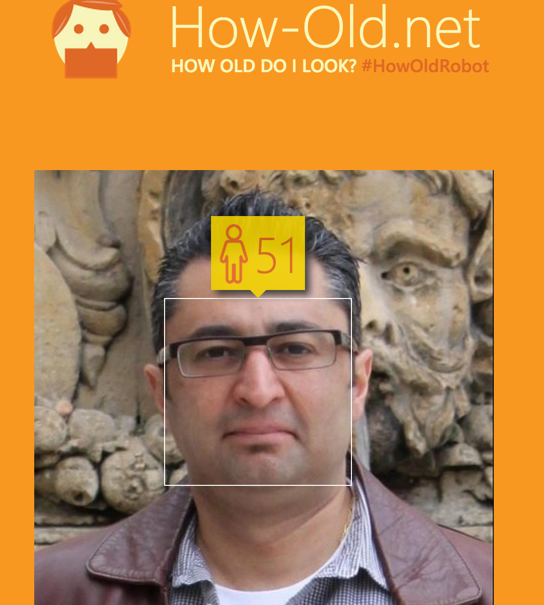
By the way, I am NOT 51...
How-old.net is an example of a Machine Learning application where instead of being an application, it could have been an API. For example (just for illustration, you could use other media types too):

POST /age_gender_classifier HTTP/1.1
Content-Type: image/jpeg
And the response:
200 OK
Content-Type: application/json

{
    "gender":"M"
    "age":37
}

Server is generating a response to the request by carrying out complex face recognition and running a model, most likely a deep network model. Server is not returning a state stored on the server, in fact this whole process is completely stateless.

And why does this matter? Well I feel if REST is supposed to move forward with our needs and use cases, it should define, clarify, internalise and finally digest edge cases. While such edge cases were pretty uncommon, with the rise and popularity of Machine Learning, such endpoints will be pretty standard.

A few days ago, on the second day of APIdays Mediterranea 2015 conference, I presented a talk on Machine Learning and APIs. And in this talk I presented simple concept of Mills. Mills, where you take your wheat to be ground and you carry back the flour.


Basically, it all goes back to the origin of a server's authority. To bring an example, a "Customer Profile" service, exposed by a REST API, is the authority to go to when another service requires access to a customer's profile. The "Customer Profile" service has defined a state, which is profile of the customers, and is responsible for ensuring integrity of the state (enforcing business rules on the state). For example, marketing email preference can have values of None, WeeklyDigest or All, it should not allow the value to be set to MonthlyDigest. We are quite used to these type of services and building REST APIs on top: CustomerProfile becomes a resource that we can query or interact with.

On the other hand, a server's authority could be exposing an algorithm. For example, tokenisation of text is a non-trivial problem that requires not only breaking the text to its words, but also maintaining muti-words and named entities intact. A REST API that exposes this functionality will be a mill.

5 constraints of a Mill

1) It encapsulates an algorithm not a state

Which was discussed ad nauseum, however, the distinction is very important. For example let's say we have an algorithm that you provide the postcode and it returns to you houses within 1 mile radius of that postcode - this is not an example of a mill.

2) Raw data in, processed data out

For example you send your text and get back the translation.

3) Calls are both safe and idempotent

Calling the endpoint should not directly change any state within the server. For example, the endpoint should not be directly mapped to the ML training engine, e.g. sending a text 1000 times skew the trained model for that text. The training endpoint is usually a normal resource, not a mill - see my slides

4) It has a single specialty

And as such, it accepts a single HTTP verb apart from OPTIONS, normally POST (although a GET with entity payload would be more semantically correct but not my preferred option for practical reasons).

5) It is named not as a verb but as a tool

A mill that exposes tokenisation, is to be called tokeniser. In a similar way, classifier would be the appropriate name for a system that classifies on top of a neural network, for example. Or normalising text, would have a normaliser mill.


No this is not the same as an RPC endpoint. No RPC smell. Honest :) That is why those 5 constraints exists.


Monday, 25 June 2012

Introducing PocoHttp: Consuming HTTP data services


Introduction

[Level T2PocoHttp is a non-opinionated Open Source .NET library for seamless consumption of HTTP data services using a familiar IQueryable<T> interface. Version 0.1 of the library is now available on GitHub - NuGet package to follow soon.

This post explains the background and motivation for this library as well as its usage and possible future directions.

Motivation and background

ASP.NET Web API exposes full richness of the HTTP spec. As such, many new avenues have been opened for creating HTTP client-server applications. Having said that, with HTTP spec aimed to be Touring-Complete, there is a client burden involved in implementing clients capable of deep protocol coherency.

ASP.NET Web API has made it easy to achieve protocol coherency as part of the HTTP pipeline - modelled as Russian Dolls (see Part 6 of the series).

With a lot of WCF services (that commonly were serving domain's value objects) soon to be moved to Web API, there is a requirement for abstracting HTTP-level aspects for seamless consumption of such services. PocoHttp is designed to provide an IQueryable<T> interface which is familiar to developers who have been working with ORMs such as Entity Framework, NHibernate, etc.

WCF Data Services are able to provide this seamless communication but they
  • Can only generate AtomPub payloads
  • As such no content negotiation or ability to generate plain XML or JSON (it does honour Accept header but returns OData specific format)
  • Use OData query syntax which is deemed by many in the community not RESTful since it assumes non-HTTP syntax coherence in the form of query string parameters on the client
  • Fully expose the data to the outside world
Hence there is a need for a .NET client library to take advantage of new HTTP features exposed in System.Net.Http to be able to consume HTTP data services whether developed in ASP.NET Web API or in any other platform. PocoHttp rises up to that challenge.

Minimal example

Before going much further into details, it might be useful to present a minimal usage of how to use it. Example below is from the PocoHttp samples (which hosts a minimal server too) available from GitHub.

var pocoClient = new PocoClient()
        {
            BaseAddress = new Uri("http://localhost:12889/api/")
        };
var list = pocoClient.Context<Car>() // calling "/api/Cars"
 .Take(1).ToList(); // getting the first item
Console.WriteLine(list[0]);

As can be seen above, pocoClient is initialised with a BaseAddress (Note the trailing slash which is mandatory for correct URI composition) and then a generic context of Car type is queried. PocoClient assumes (using the naming convention setup) that the Car should be exposed at BaseAddress + "Cars" so it makes an HTTP request and turns the result into Car objects.

PocoHttp's Grammar model

Basically PocoHttp translates IQueryable<T> queries into HTTP semantics (query string parameter in case of GET or a query criteria object in the body in case of POST) using a grammar and a set of naming convention settings - and then turns the result into .NET types using media type formatting provided by the ASP.NET Web API.


Currently, two built-in grammars are provided: OData and Pagination. OData implementation does not implement full features of OData (see below). Grammar can be implemented to translate the queries into other providers such as MongoDB or other custom syntaxes.

Normally, a grammar modifies the request by adding query string parameters. While it is not recommended, a grammar can modify the request to turn it into an HTTP POST and send a payload containing the criteria. The reason this is not recommended is that using POST method for GETting resources is not REST-friendly and responses to POST results cannot be cached while caching results of calls to data services can be very useful.

OData implementation

Current implementation of OData grammar supports below features:
  • Where: current implementation supports direct property expression. Complex property expressions (such as Car.Make.StartsWith("M")) not yet supported
  • AND, OR, greater than, lesser than, lesser than or equal, greater than or equal, not equal in WHERE expressions
  • Take
  • Skip
  • OrderBy
  • OrderByDescending 

Exposing an HTTP service in ASP.NET Web API (so that it can be consumed in PocoHttp) is simple: you just need to return IQueryable<T> from your action and decorate the action with [Queryable] attribute.

Having said that, while this feature is currently available in ASP.NET Web API RC, the future of OData support on Web API is a bit unclear as the Queryable attribute has been removed in ASP.NET Web API source code and it might not ship with RTM. As far as we can find out from ASP.NET team, OData support will be implemented using OData libraries and might ship out of band after the RTM. So the team is committed to full OData support but the timeline is unclear. As for now, you can happily use Queryable attribute in ASP.NET Web API RC.

As for PocoHttp, I am committed to implement full OData query syntax in the future releases.

Using PocoHttp against existing AtomPub OData services

Nothing prevents us to consume classic OData services that return AtomPub by just adding AtomPub media type formatter to the formatters. This will allow you to take advantage of all the niceties of HttpClient while using your existing OData services.

I will be having a post on this soon.

Disclaimer

As I initially said, this is a non-opinionated framework. You can expose your full domain model through an IQueryable<T> interface out to the client but this is not necessarily a good thing. Exposing bowels of your server and data to the outside world is an anti-pattern and could be a costly mistake. For example you can easily expose your database to the outside world allowing this query:

pocoClient.Context<Car>()
 .Where(car => car.Make.EndsWith("L"))

turn into this SQL statement that can bring down the server by having to look into each record:
SELECT * FROM CAR WHERE MAKE LIKE '%L'

Also free form Linq queries enable the client to select data using criteria which involves columns that do not have indices upon.

Pagination grammar

Pagination grammar is a simple non-OData syntax which is REST-friendlier. An example of the syntax is /api/Cars?skip=100&count=20.

Pagination vocabulary only supports 4 constructs:

  1. Skip: normally represented by skip
  2. Take: normally represented by count
  3. OrderBy: normally represented by order
  4. OrderByDescending: normally represented by orderDesc

All above representations can be changed by the client. A typical server implementation supporting these parameters will be

public IEnumerable<Car> Get(int skip, int count)
{
    return _repository.Skip(skip).Take(count);
}
As it can be seen, server implementation only supports skip and count and ignores the OrderBy and OrderByDescending.

Overriding naming convention and routing

There are times that you might want to override default route:
pocoClient.Context<Person>()
 .Where(p => p.Name == "Ali"); // calls /api/Persons?$filter=(Name eq 'Ali')
while you might want it to go to /api/Employees.

You have to ways to achieve this:

  1. To decorate your entity with EntityUriAttribute. In this case [EntityUri("Employees")]
  2. Pass the full URI as below when creating context:

pocoClient.Context<Car>("http://server/api/Employees")
 .Where(car => car.Make.EndsWith("L"))

Conclusion

In this post, we have introduced PocoHttp which is an emerging open source client library for consuming HTTP data services.

PocoHttp can be used to consume ASP.NET Web API services where IQueryable<T> is returned, existing OData services or any other HTTP data service built in other platforms - provided the grammar is implemented for the query syntax.

Using the CachingHandler in ASP.NET Web API


Introduction


[NOTE: Please also see updated post and the new framework called CacheCow
This class has been removed from WebApiContrib code and NO LONGER SUPPORTED]


[Level T3] Caching is an important concept in HTTP and comprises a sizeable chunk of the spec. ASP.NET Web API exposes full goodness of the HTTP spec and caching can be implemented as a message handler explained in Part 6 and 7. I have implemented a CachingHandler and contributed the code to the WebApiContrib in GitHub.

This post will have two sections: first a primer on HTTP caching and then how to use the handler. This code uses ASP.NET Web API RC and with .NET 4 (VS 2010 or 2012).

Background

NOTE: This topic is fairly advanced and complex. You do not necessarily need to know all this in order to use CachingHandler and are welcomed to skip it but more in-depth knowledge of HTTP could go a long way. 

Caching is a very important feature in the HTTP. RFC 2616 extensively covers this topic in section 13. Review of all the spec is beyond the scope of this post but we will briefly touch on the subject.

First of all let's get this straight: this is not about putting an object in memory as we do with HttpRuntime.Cache. In fact server does not store anything (more on this below), it only tells the client (or mid-stream cache or proxy servers) what can be cached, how long and validates the caching.

Basically, HTTP provides semantics and mechanism for the origin server, client and mid-stream proxy/cache servers to effectively reduce traffic by validating the version of the resource they have against the server and retrieve the resource only if it has changed. This process is usually referred to as cache validation.

In HTTP 1.0, server would return a LastModified header with the resource. A client/user agent could use this value and send it in the If-Modified-Since header in the subsequent GET requests. If the resource was not changed, server would respond with a 304 (Not Modified) otherwise the resource would be sent back with a new LastModified header. This would be also useful in PUT scenarios where a client sends a PUT request to update a resource only if it has not changed: a If-Unmodified-Since header is sent. If the resource has not changed, server fulfils the request and sends a 2xx response (usually 202 Accepted) otherwise a 412 (Precondition Failed) is sent.

For many reasons (including the fact that HTTP dates do not have milliseconds) it was felt that this mechanism was not adequate. In HTTP 1.1, ETag (Entity Tag) was introduced which is an opaque Id in the format of a quoted string that is returned with the resource. ETags can be strong (refer to RFC 2616 for more info) or weak in which case they start with w/ such as w/"12345". ETag works like a version ID for a resource - if two ETags (for the same resource) are equal, it means those two versions of the resource are the same.

ETag for the same resource could be different according to various headers. For example a client can send an Accept-Language header of de-DE or en-GB and server would send different ETags. Server can define this variability for each resource by using Vary header.

Cache validation for GET and PUT requests are similar but instead will use If-Match (for PUT) and If-None-Match (for GET).

Well... complex? Yeah, pretty much and yet I have not covered some other aspects and the edge cases. But don't worry! You will be abstracted from a lot of it if you use the CachingHandler.

Using CachingHandler right out of the box

OK, using the CachingHandler is straightforward especially if you go with the default settings. You can have a look at the CarManager sample in the WebApiContrib project. CarManager.Web sample demonstrate server side setup of the caching and CarManager.CachingClient for making calls to the server and testing various caching scenarios.

All you have to do is to create an ASP.NET Web API project and add the CachingHandler as a delegating handler as we learnt in Part 6:

GlobalConfiguration.Configuration.MessageHandlers.Add(cachingHandler);

And you are done! Now let's try the server with some scenarios. I would suggest that you use the CarManager sample, otherwise create a simple handler and implement GET, PUT and POST on it.

Now let's make some request and look at the response. I would suggest using Fiddler or Chrome's Postman to send requests and view the response.

So if we send a GET request:

GET http://localhost:8031/api/Cars HTTP/1.1
User-Agent: Fiddler
Host: localhost:8031

We get back this response (or similar; some headers removed and body truncated for clarity):

HTTP/1.1 200 OK
ETag: "54e9a75f2dbb4edca672f7a2c4a73dca"
Vary: Accept
Cache-Control: no-transform, must-revalidate, max-age=604800, private
Last-Modified: Thu, 21 Jun 2012 23:35:46 GMT
Content-Type: application/json; charset=utf-8

[{"Id":1,"Make":"Vauxhall","Model":"Astra","BuildYear":1997,"Price":175.0....

So we see the ETag header here along with important caching headers. Now if we make another GET call, we get back the same response but ETag and last modified stays the same.

Generating same ETag is fine (showing our CachingHandler is doing something) but we have not yet seen any caching. That is where client has to do some work to do. It has to use If-None-Match with the ETag to conditionally ask for the resource: if it matches server, it will get back 304 but if not, server will return the new resource:
GET http://localhost:8031/api/Cars HTTP/1.1
User-Agent: Fiddler
Host: localhost:8031
If-None-Match: "54e9a75f2dbb4edca672f7a2c4a73dca"
Here we get back 304 (Not modified) as expected:
HTTP/1.1 304 Not Modified
Cache-Control: no-cache
Pragma: no-cache
Expires: -1
ETag: "54e9a75f2dbb4edca672f7a2c4a73dca"
Server: Microsoft-IIS/8.0
Date: Sun, 24 Jun 2012 07:34:29 GMT

A typical server that can use CachingHandler

CachingHandler makes a few RESTful assumptions about the server for effective caching. Some of these assumptions can be overridden but generally not recommended. These assumptions are:

  • HTTP verbs (POST/GET/PUT/DELETE for CRUD operations) are used to modify resources - and not RPC-style resources (such as POST /api/Cars/Add). This is the most fundamental assumption.
  • All resources are to be modified through the same HTTP pipeline that implements caching. If a resource modified outside the pipeline, cache state needs to be updated by the same process.
  • Resource are organised in a natural cache-friendly manner: invalidation of related resources can be done with a minimal setup (more details upcoming).

Defining cache state

As we said, this has nothing to do with HttpRuntime.Cache! Unfortunately ASP.NET implementation makes it really confusing between the HTTP cache (where the resource gets cached on the client or midstream cache servers) and server caching (when the rendered output gets cached on the server).

Cache state is a collection of data that helps keep track of each resource along with its last modified date and ETag. It might initially seem that for a resource, there exists a single of such pieces of information. But as we touched upon above, a resource can have different representations each of which needs to be stored separately on the client while they will most likely invalidated together. 

For example, resource /api/disclaimer can exist in multiple languages as such client has to cache each representation separately but when disclaimer changes, all such representations need to be invalidated. That will require a storage of some sort to keep track of all this data. Current implementation comes with an in-memory storage but in a web farm scenario this needs to be a persistent store.

Cache state storage and cache invalidation

So we do not need to store the cache on the server, but we DO need to store ETag and various states on the server. If we only have a single server, this state can be stored in the memory. In a web farm (or even web garden) scenario a persisted store is needed. This store is called Entity Tag Store and is represented by a simple interface:

public interface IEntityTagStore
{
 bool TryGetValue(EntityTagKey key, out TimedEntityTagHeaderValue eTag);
 void AddOrUpdate(EntityTagKey key, TimedEntityTagHeaderValue eTag);
 bool TryRemove(EntityTagKey key);
 int RemoveAllByRoutePattern(string routePattern);
 void Clear();
}

We need to have an implementation of this interface so that the cache management can be abstracted away from controllers and instead done in the DelegatingHandlers.

Introducing some concepts (you may skip and come back to it later)

This store will keep track of the Etag (and related state stored in TimedEntityTagHeaderValue) based on an Entity Tag key which is calculated based on the resource URI and content of the important headers (which their list will be on the Vary header). In-Memory implementation for a single server is provided out of the box with CachingHandler - I would be creating a SQL-Server implementation of it very soon; watch this space.

It is important to note that change in the resource will most likely invalidate all forms of the resource so all permutations of important headers will be invalidated. So invalidation is usually performed at the resource level. Sometimes several related resources can be represented as a RoutePattern. By default, URI of a resource is its RoutePattern.

Also in some cases, change in a resource will invalidate linked resources. For example, a POST to /api/cars to add a car will invalidate /api/cars/fastest and /api/cars/mostExpensive. In this case, "/api/cars/*" can be defined as the linked RoutePattern (since /api/cars does not qualify for /api/cars/*).

Some assumptions in CachingHandler

  1. Re-emphasising that resource can only change through the HTTP API (using PUT, POST and DELETE verbs). If resources are to be changed outside the API, it is responsibility of the application to use IEntityTageStore to invalidate the cache for those resources.
  2. If no Vary header is defined by the application, CachingHandler creates weak ETags.
  3. Change in the resource will invalidates all forms of the resources (all permutations of important header values)

CarManager sample

I have considered a pretty complex and interrelated routing and caching requirement for the sample to display what is possible. Resources available are:

  1. /api/Car/{id}: GET, PUT and DELETE
  2. /api/Cars: GET and POST
  3. /api/Cars/MostExpensive: GET
  4. /api/Cars/Fastest: GET
So creating a car would invalidate cache for 2, 3 and 4. Updating car with id=1 invalidates 2,3 and 4 in addition to the car itself at /api/Car/1. Deleting a car will invalidate 2, 3 and 4.

The client sample (CarManager.CachingClinet) displays how to call the server with headers to validate the cache.

Configuring CachingHandler

Best place to start is the CarManager.Web sample to give an idea on how various setup can be used to configure complex caching requirements. Basically the points below can be used to configure the CachingHandler

Constructor

A list of request header names can be passed that will define the vary headers. If no vary header is passed, system only generates weak ETags. Also optionally an implementation of IEntityTagStore otherwise by default InMemoryEntityTagStore will be used.


EntityTagKeyGenerator

This is an opportunity to provide linked resource for a resource.

 Other customisation points

CachingHandler provides properties in the form of functions with default implementation that can be changed  to override the default behaviour which we will cover in the upcoming post on "Extending CachingHandler".


Conclusion

CachingHandler is a server-side DelegatingHandler which can be used to abstract away caching from individual ApiControllers so that controller logic can be coded without having to worry about caching. 

The  code is hosted on GitHub (currently sitting at my fork waiting to be merged merged!) and comes with both a client and server sample - CarManager.Web and CarManager.CachingClient.